


American Spaces: Strategic Infrastructure for Great-Power Competition
The South Caucasus Case for American Strategic Infrastructure
Disclaimer: The opinions expressed in this article belong to the author only and do not represent the views or policies of the US government.
An artificial intelligence platform was used as an editorial tool to improve wording, readability, and length. The reporting, analysis, opinions, and final editorial decisions are those of the author.
Russia, China, and Iran have built sophisticated influence ecosystems that shape how foreign societies learn, communicate, and align. Although they employ different methods, they share a common objective: cultivating relationships that advance their strategic interests and undermine America’s. American Spaces—US-supported centers for education, information, and community engagement— enable the United States to compete in that same arena through openness, education, entrepreneurship, and voluntary partnership.
Introduction
Great-power competition is a contest for the next generation. Military strength and economic leverage remain essential, but institutions and networks determine how future leaders think, whom they trust, and ultimately how their countries align.
The United States already possesses one of its most effective platforms for competing in that environment. American Spaces are US-supported public engagement centers overseas that connect local communities with American education, information, technology, and opportunity. They operate in nearly 600 locations worldwide and give the United States sustained access to strategically important communities where competition is already underway.[i] They cultivate future leaders, extend American presence beyond embassy walls, strengthen economic ties, and offer a trusted alternative to authoritarian influence.
The South Caucasus illustrates this competition in its clearest form. Armenia, Azerbaijan, and Georgia sit at the intersection of Russian security ambitions, Chinese economic expansion, Iranian regional influence, and Western energy and transportation interests.[ii], [iii], [iv] The South Caucasus demonstrate how American Spaces counter authoritarian influence while advancing US economic, diplomatic, and security objectives at minimal cost.
American policymakers would never willingly surrender a strategic port, telecommunications network, or airfield in contested territory. Yet the United States routinely underinvests in the educational and informational infrastructure that shapes future leaders, partners, and alliances. The case studies that follow demonstrate why American Spaces deserve to be understood not as cultural amenities, but as strategic infrastructure for great-power competition.
Strategic Return on Investment
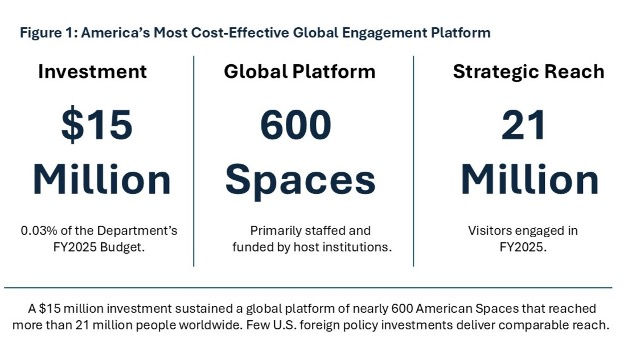
American Spaces deliver one of the highest strategic returns per dollar in the US foreign affairs toolkit. In FY2025, they welcomed more than 21 million visitors worldwide on a budget of just $15 million—approximately $0.71 per visitor engagement and only 0.03 percent of the Department of State's FY2025 budget.[v], [vi] Local institutions frequently provide facilities, pay staff, and offer operational support, allowing relatively modest US investments to sustain a global platform that projects American presence, expands strategic access, and cultivates future partners at extraordinary scale.[vii]
Extending America's Strategic Reach
American Spaces extend the reach of every US embassy without requiring the United States to build and staff additional facilities. While embassies primarily engage governments and national leaders, American Spaces cultivate relationships with future leaders in the communities where they live and work.

Of the nearly 600 American Spaces worldwide, 365 are in cities without a permanent US diplomatic presence, allowing the United States to sustain engagement in places where American diplomats would otherwise have no permanent presence.[viii] The networks project American presence into border regions, secondary cities, university towns, and underserved communities where authoritarian competitors compete for influence.
This reach depends less on any single facility model than on maintaining an American presence. In Armenia, local governments have repeatedly offered facilities and operational support to expand the network into every province.[ix] Elsewhere, storefront locations or public-private partnerships may provide greater flexibility and resilience than host-institution models.[x] The strategic objective is consistent: maintain trusted, American access wherever competition for future leaders is unfolding.
Economic Statecraft
Economic competition extends beyond trade, investment flows, and infrastructure projects. It is also a competition to shape the workforce, technological preferences, and professional networks that determine future patterns of trade and investment, long before governments decide whom to trust as economic partners.[xi]
American Spaces compete in precisely that environment. Through education, entrepreneurship, media literacy, and US higher education advising, they prepare future business leaders and skilled professionals to compete in an economic ecosystem built on transparency, innovation, and global engagement.[xii]Rather than dictate commercial decisions, they shape the human capital that ultimately makes them.
This approach offers the United States a lasting competitive advantage. American Spaces introduce participants to American educational institutions, entrepreneurial culture, and business practices while expanding familiarity with technologies, professional norms, and commercial standards widely used by US firms. The result is a workforce better prepared to make trade and investment deals with American companies and participate in a rules-based global economy.
Unlike authoritarian competitors that cultivate dependence through state-directed investment or political patronage, American Spaces invest in people. They expand opportunity rather than dependency. This advantage compounds over time as participants become entrepreneurs, business executives, educators, and public officials.
One Platform, Three Competitors
Few regions better illustrate the strategic value of American Spaces than the South Caucasus. Armenia, Azerbaijan, and Georgia sit at the intersection of Russian security ambitions, Chinese economic expansion, Iranian regional influence, and Western energy and transportation interests. Great-power competition is not an abstract contest between states in this region but a competition between rival influence ecosystems. Russia, China, and Iran have spent years building cultural centers, educational partnerships, religious networks, and elite relationships designed to shape the region's geopolitical orientation.[xiii] American Spaces provide one of the few US platforms capable of competing across all three countries simultaneously.
Armenia: Competing for Armenia’s Strategic Orientation
Armenia is undergoing the most consequential geopolitical realignment in the South Caucasus since the collapse of the Soviet Union. Russia’s failure to support Armenia during the Nagorno-Karabakh crisis prompted Yerevan to accelerate its outreach to the United States and Europe, creating a rare opportunity to reduce Moscow’s long-standing influence.[xiv] The Kremlin, however, maintains an entrenched influence infrastructure designed to preserve Armenia's political, cultural, and informational dependence on Russia.[xv]
That infrastructure extends far beyond traditional diplomacy. Three Russian Houses anchor a broader ecosystem of Russian educational partnerships, cultural programming, media outlets, think tanks, and youth organizations that reinforce pro-Kremlin narratives and sustain Russia’s presence in Armenian society.[xvi], [xvii] The Russian House in Yerevan regularly hosts lectures, seminars, exhibitions, youth camps, and historical programming that promote Russia as Armenia’s indispensable strategic partner and portray the West as an unreliable alternative.[xviii] These institutions are not simply cultural centers—they are vectors of Russian malign influence with known intelligence links designed to preserve Moscow’s influence over Armenia’s strategic orientation.[xix]
American Spaces compete in that environment. Across five locations, they expand access to independent information, English-language education, entrepreneurship, digital literacy, and civic engagement while cultivating relationships with globally connected youth, entrepreneurs, journalists, educators, and future policymakers. Rather than reinforcing dependence on any external power, they equip participants with the skills, networks, and confidence to engage the United States and the broader international community on their own terms.
The investment is already paying strategic dividends. Armenia’s ministers of economy, justice, and education, along with the president of the National Assembly, are alumni of US programs, some of whom first engaged with the United States through American Spaces. These relationships have proved vital when negotiating the historic Armenia-Azerbaijan peace agreement and the implementation of the Trump Route for International Peace and Prosperity. The contest is therefore not simply over Armenia’s current foreign policy. It is over who shapes the country’s next generation of leaders. American Spaces ensure the United States competes in that contest.
Georgia: Competing with China for Human Capital
Georgia occupies a pivotal position on the Middle Corridor linking Europe and Asia while bypassing Russia and Iran. Beijing recognizes that Georgia's future will not be determined solely by ports, railways, or energy infrastructure.[xx] It will also be shaped by the institutions, technologies, and professional networks that influence the country's next generation of leaders.[xxi]
China has therefore pursued a strategy of institutional integration. Through four Confucius Institutes, university partnerships, technology projects, and educational exchanges, Beijing is embedding its technical standards, cultivating future elites, and normalizing dependence on Chinese economic and technological ecosystems.[xxii], [xxiii]
The United States competes differently. Across Georgia's network of nineteen American Spaces, participants develop English-language proficiency, entrepreneurial skills, digital literacy, and familiarity with American educational institutions and business practices. These programs strengthen the human capital that underpins economic competitiveness while connecting participants to American rather than Chinese professional networks.

The network's greatest advantage is its geographic reach. While much of China's engagement concentrates on national institutions and urban elites, American Spaces extend well beyond Tbilisi into strategically important communities including Marneuli, Pankisi Gorge, and Akhalkalaki, regions where Iranian, extremist, and Russian influence respectively remain active. The network also projects US reach and influence into the Russian-occupied territories of Abkhazia and South Ossetia with five Spaces on the regions’ borders. This distributed presence allows the United States to compete for relationships in places traditional diplomacy reaches only intermittently.
Azerbaijan: Simultaneous Strategic Competition
Azerbaijan is at the nexus of Caspian energy infrastructure, the Middle Corridor, Russia's southern periphery, and Iran's northern border. Its geography makes it indispensable to European energy security, East–West trade, and regional stability, ensuring that Moscow, Beijing, and Tehran all compete to shape its orientation.[xxiv]
Each competitor pursues a different strategy. Iran seeks to expand its influence through religious outreach, information operations, and cultivation of pro-Iranian constituencies, particularly among border communities and economically vulnerable populations.[xxv] A network of cultural centers, religious organizations, media outlets, and charitable institutions promotes narratives portraying Western integration as culturally corrosive while strengthening ideological ties with Tehran.[xxvi]
China competes through a different model. Under its Belt and Road Initiative and the Comprehensive Strategic Partnership with Baku, China is embedding itself across Azerbaijan's transportation, energy, education, and technology sectors.[xxvii] More than 160 university partnerships, expanding Chinese language programs, and elite educational exchanges are designed to shape the workforce, institutions, and future leaders who will determine Azerbaijan's economic trajectory.[xxviii]
Until late 2023, American Spaces gave the United States an effective platform to compete. Across the network, young Azerbaijanis developed English-language proficiency, entrepreneurial skills, digital literacy, media literacy, and STEM capabilities while building relationships with American educational and professional institutions grounded in openness, innovation, and voluntary partnership.[xxix]
A Natural Experiment in Strategic Competition
Nothing demonstrates the strategic value of American Spaces more clearly than their forced closure in Azerbaijan. The dismantling of the network in late 2023 revealed what happens when the United States loses its primary platform for sustained engagement while strategic competitors remain active.
Before the closures, the US Embassy operated seven American Spaces: a flagship center in Baku and six regional Spaces, including locations near Azerbaijan's borders with Russia and Iran. In FY2023 alone, they welcomed more than 34,000 visitors through 1,027 programs that delivered English-language instruction, entrepreneurship training, media literacy, STEM education, financial literacy, and maker programs in robotics, coding, and 3D design.[xxx] American Spaces denied America's competitors uncontested access to Azerbaijan's next generation of leaders.

Between October and December 2023, Azerbaijani authorities systematically dismantled that infrastructure. The closures occurred amid deteriorating bilateral relations and were officially attributed to expired memoranda of understanding. They were accompanied by bureaucratic obstruction, police questioning of local staff, and state-aligned media campaigns portraying US-supported activities as components of an intelligence network.[xxxi] Within months, the United States had lost its principal mechanism for engaging regional communities beyond the embassy compound. The vacuum did not remain empty.
Russia expanded its cultural footprint, including three new Russian Houses in cities where American Spaces had operated.[xxxii] China was equally aggressive, nearly doubling its presence from four to seven Confucius Institutes and branches, taking over previous American facilities and relationships.[xxxiii] Iran simultaneously broadened its cultural outreach through new agreements and reciprocal programming targeting border communities.[xxxiv]
The pattern is unmistakable. As American influence infrastructure contracted, Russian, Chinese, and Iranian influence infrastructure expanded into the same physical, educational, and informational terrain (In early 2025, Azerbaijan closed all Russian Houses following Russia’s December 2024 downing of Azerbaijan Airlines Flight 8243).[xxxv]
The lesson extends far beyond Azerbaijan. American Spaces do more than host programs—they deny strategic competitors uncontested access to future leaders, regional communities, and trusted local institutions. When they disappear, those relationships are captured by America's competitors.
Conclusion
The South Caucasus demonstrates a broader truth about twenty-first-century statecraft: great-power competition is a contest for human terrain. Russia, China, and Iran compete through different instruments, but all seek to shape the people, institutions, and relationships that determine geopolitical alignment.
The United States possesses a competitive advantage that authoritarian powers cannot easily replicate. American Spaces do not compete through coercion, censorship, or dependency. They compete by expanding opportunity. Through education, entrepreneurship, technology, and enduring local partnerships, they cultivate trust, skills, and relationships that shape geopolitical alignment. Those relationships are voluntary, locally sustained, and therefore more resilient because people choose them freely.
Infrastructure shapes power. American policymakers readily recognize the strategic value of ports, airfields, telecommunications networks, and energy infrastructure. The same logic should apply to the infrastructure that shapes future leaders, partners, and alliances. American Spaces are not cultural amenities. They are strategic infrastructure that extends American reach, strengthens economic competitiveness, and enables the United States to compete where authoritarian rivals are already investing heavily.
The question is not whether the United States can afford American Spaces. It is whether it can afford to cede the strategic terrain they occupy.
__________
Amaury Munoz supports a network of 27 American Spaces across Armenia, Azerbaijan, Belarus, Georgia, and Russia, as a Washington-based public diplomacy desk officer. Previously, Amaury managed the two American Spaces network in Morocco as the Cultural Affairs Officer at the US Consulate Casablanca. Following Czech language study, Amaury will manage the four American Spaces network in Czechia as the deputy public engagement officer.
[i] "American Spaces," U.S. Department of State, September 15, 2025, https://www.state.gov/american-spaces.
[ii] Rina Nikolaeva, "Kremlin Has Increased Spending on Expanding Its Network of Loyal Young Leaders, Journalists, and Bloggers Abroad by 1.5 Times," IStories, September 16, 2025, https://istories.media/en/stories/2025/09/16/rossotrudnichestvo-2025/.
[iii] Eleanor Albert, "China's Big Bet on Soft Power," Council on Foreign Relations, February 9, 2018, https://www.cfr.org/backgrounders/chinas-big-bet-soft-power.
[iv] Maryam Sinaiee, "Pezeshkian under Fire for Boosting Funding to Propaganda Institutions," Iran International, February 25, 2025, https://www.iranintl.com/en/202502248696.
[v] "American Spaces" (State Dept.).
[vi] "FY 2027 Congressional Budget Justification – International Affairs Budget," U.S. Department of State, 2026, https://www.state.gov/fy-2027-international-affairs-budget/.
[vii] "American Spaces" (State Dept.).
[viii] "American Spaces Locator," Americanspaces.info, 2026, https://americanspaces.info/locator/map.
[ix] U.S. Embassy Yerevan Public Diplomacy Officer, interview by Amaury Munoz, virtual, June 3, 2026.
[x] U.S. Embassy Baku Public Diplomacy Officer, interview by Amaury Munoz, virtual, June 3, 2026.
[xi] Justin Muzinich, Gina Raimondo, James Taiclet, Jonathan Hillman, and Anya Schmemann, U.S. Economic Security (Council on Foreign Relations Task Force Report, November 14, 2025), https://www.cfr.org/task-force-reports/us-economic-security.
[xii] 2024 American Spaces Annual Report (U.S. Department of State, August 5, 2025), https://americanspaces.state.gov/wp-content/uploads/sites/292/2024-Annual-Report_Digital-Version_AUG_2025.pdf.
[xiii] John Calabrese, "China-Russia Engagement and Iran: Toward a Sturdy and Enduring Entente?," Journal of South Asian and Middle Eastern Studies 48, no. 1 (2024): 1–17, https://dx.doi.org/10.1353/jsa.2024.a970314.
[xiv] SpecialEurasia OSINT Team, "Russia's Cultural Diplomacy in Armenia and Azerbaijan," SpecialEurasia, April 9, 2025, https://www.specialeurasia.com/2025/04/09/russia-culturale-caucasus/.
[xv] "Armenia's Push for Autonomy Meets Russian Resistance," Stratfor Worldview (RANE), 2026, https://worldview.stratfor.com/article/armenias-push-autonomy-meets-russian-resistance.
[xvi] Nadiia Koval, Maryna Irysova, Serhiy Tytiuk, and Denys Tereshchenko, "Rossotrudnichestvo: The Unbearable Harshness of Soft Power" (Ukrainian Institute's Department of Information and Analytics, n.d.).
[xvii] Peter D. Eckel, "Armenia," in Governing Universities in Post-Soviet Countries (September 2023): 35–45, https://doi.org/10.1017/9781009105224.006.
[xviii] Sergey Kanev, "Grabbing Him by the 'Beard': The Insider Identifies the FSB, GRU, and SVR Agents Russia Sent to Armenia to Take on PM Nikol Pashinyan," The Insider, May 19, 2026, https://theins.press/en/inv/292740.
[xix] Kanev, "Grabbing Him by the 'Beard.'"
[xx] U.S. Embassy Tbilisi, "Confucius Institutes Advance Chinese Propaganda on Campuses," U.S. Embassy in Georgia, August 27, 2020, https://ge.usembassy.gov/confucius-institutes-advance-chinese-propaganda-on-campuses/.
[xxi] Miro Popkhadze, "China's Georgian Gamble," Foreign Policy Research Institute, March 17, 2025, https://www.fpri.org/article/2025/03/chinas-georgian-gamble/.
[xxii] Civic IDEA, "Emerging Concern: Chinese Surveillance Cameras in Georgia" (Tbilisi: Civic IDEA, January 2025), https://civicidea.ge/wp-content/uploads/2025/01/EMERGING-CONCERN-Chinese-Surveillance-Cameras-in-Georgia.pdf.
[xxiii] Civic IDEA, "Emerging Concern."
[xxiv] Zeming Zhang, "Bridging Eurasia: China-Azerbaijan Relations, the Middle Corridor, and the Belt and Road Initiative," Hague Research Center, 2025, https://hagueresearch.org/bridging-eurasia-china-azerbaijan-relations-the-middle-corridor-and-the-belt-and-road-initiative/.
[xxv] Arash Aalaei, "Iran's Pressure on Azerbaijan: Two Birds with One Stone," Washington Institute for Near East Policy, April 21, 2023, https://www.washingtoninstitute.org/policy-analysis/irans-pressure-azerbaijan-two-birds-one-stone.
[xxvi] Iranian Influence in the South Caucasus and the Surrounding Region: Hearing before the Subcommittee on Europe and Eurasia of the Committee on Foreign Affairs, House of Representatives, 112th Cong., 2nd sess., December 5, 2012, https://www.congress.gov/event/112th-congress/house-event/LC3789/text.
[xxvii] "Azerbaijan and China Signed Joint Statement on Establishment of Comprehensive Strategic Partnership," President.Az, 2025, https://president.az/en/articles/view/68634.
[xxviii] Aksana Akhmedova, "Azerbaijan: Advancing Robust Educational Ties with China," Ceias, July 22, 2025, https://ceias.eu/azerbaijan-advancing-robust-educational-ties-with-china/.
[xxix] "American Spaces," U.S. Embassy in Azerbaijan, accessed July 12, 2026, https://az.usembassy.gov/education/american-spaces/.
[xxx] "American Spaces" (Embassy Baku).
"Azerbaijan: Journalists Arrested as State Media Signal Hunt for 'U.S. Spies,'" Eurasianet, November 21, 2023, https://eurasianet.org/azerbaijan-journalists-arrested-as-state-media-signal-hunt-for-us-spies.
[xxxii] Former U.S. Embassy Baku Public Diplomacy Officer, interview by Amaury Munoz, virtual, June 3, 2026.
[xxxiii] Akhmedova, "Educational Ties with China."
[xxxiv] "Iran, Azerbaijan to Organize Bilateral Cultural Weeks," Tehran Times, September 14, 2025, https://www.tehrantimes.com/news/517848/iran-azerbaijan-to-organize-bilateral-cultural-weeks.
[xxxv] Elena Teslova, "Azerbaijan Terminates Operations of Russian House in Baku," Anadolu Agency, February 6, 2025, https://www.aa.com.tr/en/asia-pacific/azerbaijan-terminates-operations-of-russian-house-in-baku/3474115.
Comments